
Anthropic signed a $5B multi-year hardware pact with AMD: why your inference costs are about to drop (or not)
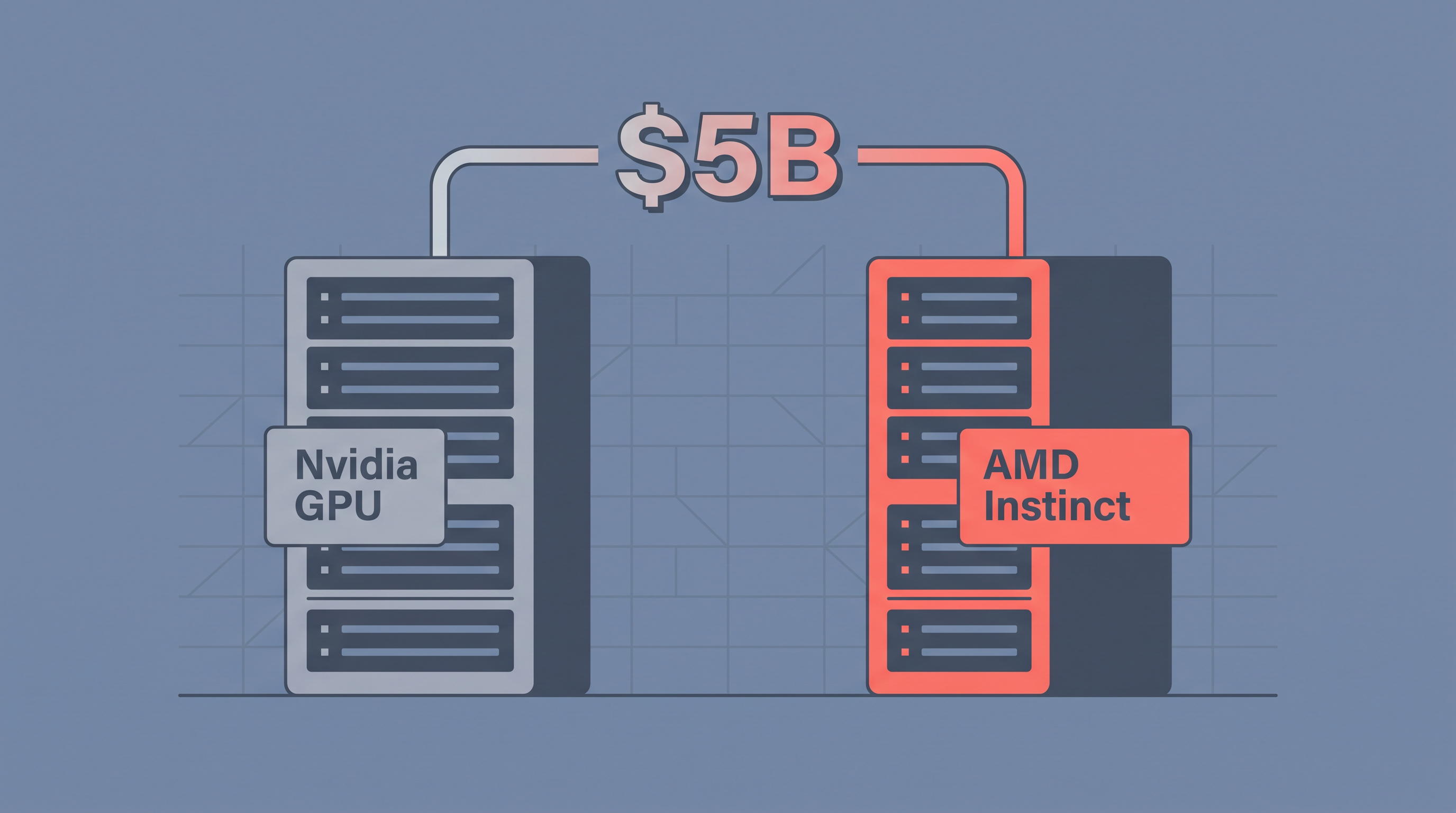
Short answer (60 seconds): Anthropic announced the week of July 28, 2026 a multi-year agreement with AMD: strategic equity investment of up to USD 5B in Anthropic plus access to up to 2 gigawatts of AMD Instinct MI450 GPUs in Helios systems, first deployment phase in H1 2027 (source). It is the first serious move by a frontier lab to diversify inference hardware beyond Nvidia. Combined with the USD 250B OpenAI owes Nvidia (covered yesterday), GPU supply is fragmenting — which should translate into downward pressure on the inference price your SaaS pays. When? Probably 12-18 months, not tomorrow. How much? Optimistic 20-40% on list price. The smart play is not to sign long annual contracts yet without a price-reset clause.
The practical question for a SaaS founder is direct: do I wait for inference prices to drop or sign an annual contract with Claude now? The answer: it depends on your volume, but the direction of the market is clear.
Disclosure: I do not have access to Anthropic financials beyond what is public. The inference cost projections are my own analysis based on public pricing (Anthropic, OpenAI, AWS Bedrock, GCP Vertex AI) and the 2026 pattern of price drops (Opus 4.7 -33% in March, Sonnet 5 -60% in July). Technical detail almost nobody looks at: Sonnet 5's new tokenizer can consume up to 35% more tokens than Sonnet 4 for the same content (source ThursdAI) — that eats part of the lower-price savings.
What happened this week (and why it matters)
Anthropic closed a multi-year deal with AMD with two components (source Updated Bulletins):
1. USD 5B of equity investment from AMD into Anthropic. Not a hardware purchase contract — capital. AMD enters as a strategic investor, getting an anchor customer reference in the frontier AI world and aligning incentives for the ROCm stack to be competitive with CUDA. For Anthropic it is fresh capital to build data centers without depending 100% on Nvidia.
2. Up to 2 gigawatts of AMD Instinct MI450 GPUs in Helios rack systems. An obscene amount of compute. 1 GW of MI450 is enough to serve frontier inference at millions of requests per second scale. The first phase (1 GW) deploys in H1 2027. Additionally there is deep collaboration with AMD to use Claude optimizing ROCm and the MI450 workloads.
3. Macro context: GPU supply is fragmenting. Yesterday we covered the Nvidia-OpenAI USD 250B deal. Today the Anthropic-AMD deal. Frontier labs are building redundant supply chains: Nvidia is still the dominant provider, but AMD and Google TPU are entering with anchor contracts. For the inference buyer (your SaaS) that is structurally positive: more providers competing = downward pressure on list price.
Three adjacent data points that frame the practical decision:
- Anthropic moved its inference margin from 38% to 70% in 2026 per Forbes, driven by Claude Code (source). Anthropic already has the playbook to lower prices without breaking unit economics.
- Token price fell from ~USD 10/MTok to USD 2.50/MTok in 12 months per Ramp's own data (source). 75% drop, not magic: competition, scale and better hardware.
- Nvidia Rubin promises another 10x reduction in token cost vs Blackwell (source). If it ships, in 18-24 months you could be paying 1/10 of today's price for the same quality.
Hardware strategies across the three frontier labs (July 2026)
| Frontier lab | Main hardware | Diversification | Guaranteed compute | July 2026 status |
|---|---|---|---|---|
| Anthropic | Nvidia (majority) | AMD MI450 (new), Google TPU via Vertex | Up to 2 GW AMD in H1 2027 + Nvidia | AMD deal closed; Sonnet 5 at $2/$10 intro |
| OpenAI | Nvidia (almost exclusive) | Google TPU (limited) | USD 250B guaranteed to Nvidia | $5.7B revenue Q1 2026; GPT-5.6 launched Jul 9 |
| Google DeepMind | In-house TPU | Nvidia (via Vertex for customers) | N/A — vertically integrated | Gemini 3.5 in production; Managed Agents free |
Reading the table:
- Anthropic is the first to exit the Nvidia monoculture. The AMD deal is not cosmetic — 2 GW of MI450, not a pilot. It is a market message: "we have a plan B if Nvidia squeezes our supply or price".
- OpenAI is still almost 100% dependent on Nvidia. The USD 250B deal is guaranteed compute in exchange for deep lock-in. If Nvidia raises list price 20%, OpenAI cannot move to AMD without renegotiating.
- Google is vertically integrated. Its TPU is internal, serves Gemini and is offered to third parties via Vertex AI. Enterprise pricing is more opaque.
For your SaaS, what matters is that Anthropic has the strongest incentive to drop list price: it wants enterprise customers to grow fast on MI450 to amortize the investment, and knows OpenAI cannot keep up there. That is the window you need to capture.
What "Anthropic + AMD" means for your unit economics
The headline — "your inference cost is about to drop" — is not automatic. It depends on three things: (1) when AMD hardware ships, (2) whether AMD delivers Nvidia-comparable performance, (3) whether Anthropic passes the savings through.
Base case: Spanish-language B2B SaaS with 5,000 MAU, 40,000 conversations/month with an AI agent. Each call uses:
- Input: system prompt + user context + history. 2,200 tokens in Spanish with Sonnet 5's new tokenizer (+35% vs prior tokenizer).
- Output: agent response. 600 tokens.
- 60% cache hit rate on the system prompt (realistic for multi-turn agents).
| Scenario | Fresh input | Cached input | Output | Total/month | Yearly savings |
|---|---|---|---|---|---|
| A: today, Sonnet 5 $2/$10 intro | $0.0704 | $0.0106 | $0.240 | $320 | baseline |
| B: 12-18 mo, -25% list ($1.50/$7.50) | $0.0528 | $0.0079 | $0.180 | $240 | USD 960 |
| C: optimistic, -40% list ($1.20/$6) | $0.0422 | $0.0063 | $0.144 | $193 | USD 1,524 |
Not transformational at first glance, but the important number is the COGS share. If the SaaS charges USD 29/month for Pro users with 500 Pro users = USD 14,500 MRR, target 70% gross margin = max COGS USD 4,350/month. If inference today is USD 1,200/month, that is 28% of COGS. Drop to USD 720/month in the optimistic scenario and it is 17% — 11 margin points back in your pocket without touching price.
For SaaS founders: if your SaaS has 30-60% of COGS in inference (typical when the AI agent is the product core), a 25-40% drop in token price translates to 7-25 gross margin points. That can be the difference between break-even and profitability, or between raising the next round and not needing to.
Calculation disclaimer: the tokens assume an agent with a ~600-token system prompt. If your agent is simpler the absolute savings are smaller but the percentage is the same. Run your own calculation with your real traffic before deciding.
What to audit in your SaaS this week
Operational checklist to run between Monday and Friday. The idea is to have evidence for the next planning with the CFO, not intuition.
1. Look at your workload mix by task type. 70% of calls in a typical SaaS are classification/extraction that does not need an expensive model. Pull a report for the last 30 days: how many calls go to Opus vs Sonnet vs Haiku (or Sol vs Terra vs Luna if you are on OpenAI). If you have >50% of calls on the most expensive tier and <20% of your usage requires it, you are overpaying. The typical mix I see: 50% Haiku-equivalent, 35% Sonnet-equivalent, 15% Opus-equivalent. If yours is very different, you have a quick win.
2. Turn on prompt caching if you have not already. For Sonnet 5, cache read costs $0.20/MTok during the intro — 10x cheaper than fresh input. Most SaaS products with a system prompt >500 tokens see hit rates of 50-70% without any changes. If your hit rate is <30%, your architecture probably breaks cache between calls. That bug is worth USD 200-2,000/month depending on volume.
3. Measure the impact of Sonnet 5's new tokenizer. If you migrated from Sonnet 4 to Sonnet 5 and did not update your token assumptions, you may be paying more than before. The ThursdAI report indicates the new tokenizer can consume up to 35% more tokens for the same text. If your usage rose >10% without traffic rising, the tokenizer is the culprit. Consider staying on Sonnet 4 ($3/$15 regular) until list price drops via the AMD deal, or renegotiate your plan.
4. Negotiate commit pricing only if your volume justifies it. If you spend >USD 5K/month, contact Anthropic (or AWS Bedrock / GCP Vertex AI) for a 3-12 month commit with 10-20% discount. But: ask for a "price reset" clause — if Anthropic drops list price during your commit, your effective price drops proportionally. If you spend <USD 1K/month, pay on-demand and keep full flexibility.
5. Build your dual-provider plan. Do not wait for AMD. The fastest way to capture savings today is routing by task type between Anthropic and OpenAI. Cheap classification: Haiku 4.5 ($1/$5) or GPT-5.6 Luna ($1/$6). Mid generation: Sonnet 5 ($2/$10) or GPT-5.6 Terra ($2.50/$15). Long reasoning: Opus 4.8 ($5/$25) or GPT-5.6 Sol ($5/$30). Dual-provider with routing cuts your invoice 30-50% without waiting for AMD hardware.
When NOT to sign an annual contract with Anthropic now
A CFO's instinct with a USD 5B deal in the news is to say "lock the price in". Three cases where that decision can backfire:
1. Your volume is variable and you are still in product-market-fit. If your traffic could double or halve in 6 months (normal for a startup), an annual commit locks you to a volume you may not reach. Rule: never commit more than 3 months of your current burn rate. If the AMD deal materializes in 12 months with 25% savings, losing 3 months of flexibility costs more than the 10-20% discount you get today.
2. You are considering migrating some workload to OpenAI or Google. The AMD deal is about Anthropic hardware. If diversifying providers is the right move (and for most SaaS it is), an annual commit with Anthropic locks you to one vendor. Keep on-demand until your routing strategy is final.
3. The first gigawatt of MI450 does not come online until H1 2027. AMD hardware is future upside, not immediate benefit. If you want to bet on AMD delivering Nvidia-comparable performance in 12 months, do it with on-demand cash, not cash locked in a commit. When it DOES make sense to sign: if your volume is predictable (>USD 20K/month for 6+ months), your product is stable, and you want to secure capacity in a tight-supply context, a commit with a price-reset clause gives you cost predictability. But that is the exception, not the rule, for a SaaS.
Three operational practices that apply wherever you are
Regardless of the AMD deal or what happens with token prices in 18 months, there are three optimizations that cut your inference invoice 30-60% combined:
1. Route by task, not by single default model. A support agent does not need Opus 4.8 to classify (Haiku 4.5 is enough) or Sonnet 5 to extract structured data. Assign each product feature to the cheapest tier that can do it well. This alone cuts the invoice 30-50%. What it requires: instrumenting which task triggers each call and having an eval suite that tells you when a downgrade breaks quality.
2. Cache everything you can cache. System prompts, tools, few-shot examples, user context that repeats across turns — all of that should live in cache. Sonnet 5 cache read at $0.20/MTok (intro) or $0.30 (regular) is 10-25x cheaper than fresh input. In a multi-turn agent, a realistic hit rate is 60-80%. If you are at 20-30%, you have an architecture problem.
3. Monitor cost per tenant and per feature, not just globally. The "all API cost on one line" pattern hides which tenants are profitable and which generate negative margin. Once you have per-tenant cost, you can (a) cap outliers before they burn your invoice, (b) upgrade power users with justification, (c) charge a premium for expensive features that only some use. This does not cut the total invoice — it cuts the unit COGS per profitable user, which is what matters for pricing.
Conclusion
The Anthropic-AMD deal is the most important news of the week for the long-term direction of inference cost. In the short term, nothing changes: your August Claude invoice will look like July's. In 12-18 months, if AMD delivers Nvidia-comparable performance and Anthropic passes the savings through, you could be paying 20-40% less per token. The mistake would be to sign a long annual commit today and end up paying the old price while the market drops.
Three operational recommendations for this week:
- Do not sign an annual commit yet without a price-reset clause. The AMD deal pushes list price down in 12-18 months.
- Route by task type between Sonnet 5, Haiku 4.5 and GPT-5.6 Luna/Terra. 30-50% invoice drop with a weekend of work, no AMD wait required.
- Re-measure the impact of Sonnet 5's new tokenizer. If your token usage rose >10% without traffic rising, the tokenizer is eating your margin.
If your SaaS runs on Claude or you are considering migrating from GPT-5.6 and you want to validate the actual impact on your numbers before committing, book a free 30-minute call — in 20 minutes we can usually calculate your monthly savings with your real workload mix and the optimal window to commit or wait.
Read also:
- Nvidia just put $250B on the line so OpenAI can lease a data center — the complementary context: the other side of the same trade.
- Claude Sonnet 5 at $2/$10: inference cost dropped up to 80% — the introductory price drop that anticipates this trend.
- Claude vs ChatGPT API: what each Spanish-language response costs in 2026 — comparison focused on ES vs EN tokenization.
- 74% of your users are mentally replacing you — the adoption context that drives the downward pressure on price.
- Back to the blog — all articles.
Frequently asked questions
What exactly is the Anthropic-AMD deal?
A multi-year agreement announced the week of July 28, 2026 with two components: (1) AMD commits up to USD 5B of strategic equity capital in Anthropic; (2) Anthropic secures access to up to 2 gigawatts of AMD Instinct MI450 GPUs in Helios rack systems, with deep collaboration on the ROCm stack. The first gigawatt comes online in H1 2027. It does not replace Nvidia — it diversifies.
How much will inference prices drop for my SaaS?
Short term (6 months): probably not much, the first GW of MI450 does not come online until H1 2027. Medium term (12-18 months): a 20-40% drop in Anthropic list price is plausible if AMD delivers Nvidia-comparable performance at lower per-chip cost. Bottom line: if you are thinking of an annual Claude contract, price the current quote + 15% buffer and ask for a price-reset clause.
Why does this matter to a SaaS founder?
Because inference cost is typically 30-60% of COGS for a SaaS that uses LLMs. A 30% drop in inference cost lifts gross margin by 9-18 points without touching price. That changes the viability of products currently at break-even and the "build vs buy" math for AI features. It is the same exercise Anthropic already ran: their inference margin went from 38% to 70% in 2026 per Forbes, with annualized revenue near USD 45B.
Should I sign an annual contract with Anthropic now or wait?
Depends on volume. If you spend >USD 5K/month, a commit with 10-20% discount makes sense — but ask for a "price reset" clause if Anthropic drops list price within 6 months. If you spend \<USD 1K/month, pay on-demand. Rule of thumb: never commit more than 3 months of your current burn rate. Also: Sonnet 5's new tokenizer can burn up to 35% more tokens than Sonnet 4 for the same content.
What if I want to diversify providers instead of waiting for AMD?
Dual-provider with routing by task type is the play I see work most often. Cheap classification: Haiku 4.5 ($1/$5) or GPT-5.6 Luna ($1/$6). Mid reasoning: Sonnet 5 or GPT-5.6 Terra. Long reasoning: Opus 4.8 or GPT-5.6 Sol. 60-70% of calls in a typical SaaS are classification/extraction — that is where the immediate savings sit, without waiting for AMD hardware.